


 Deutsch
 Tiếng Việt
 日本語
日本語 한국어
한국어 ไทย
ไทย Português
 العربية
 Français
 Español
 Italiano
 Nederlands
 Svenska
 Norsk
Norsk Dansk
Dansk Polski
 Русский
 Türkçe
 Bahasa Indonesia
 Bahasa Melayu
Subwoofer Placement Guide: Trunk vs Under-Seat
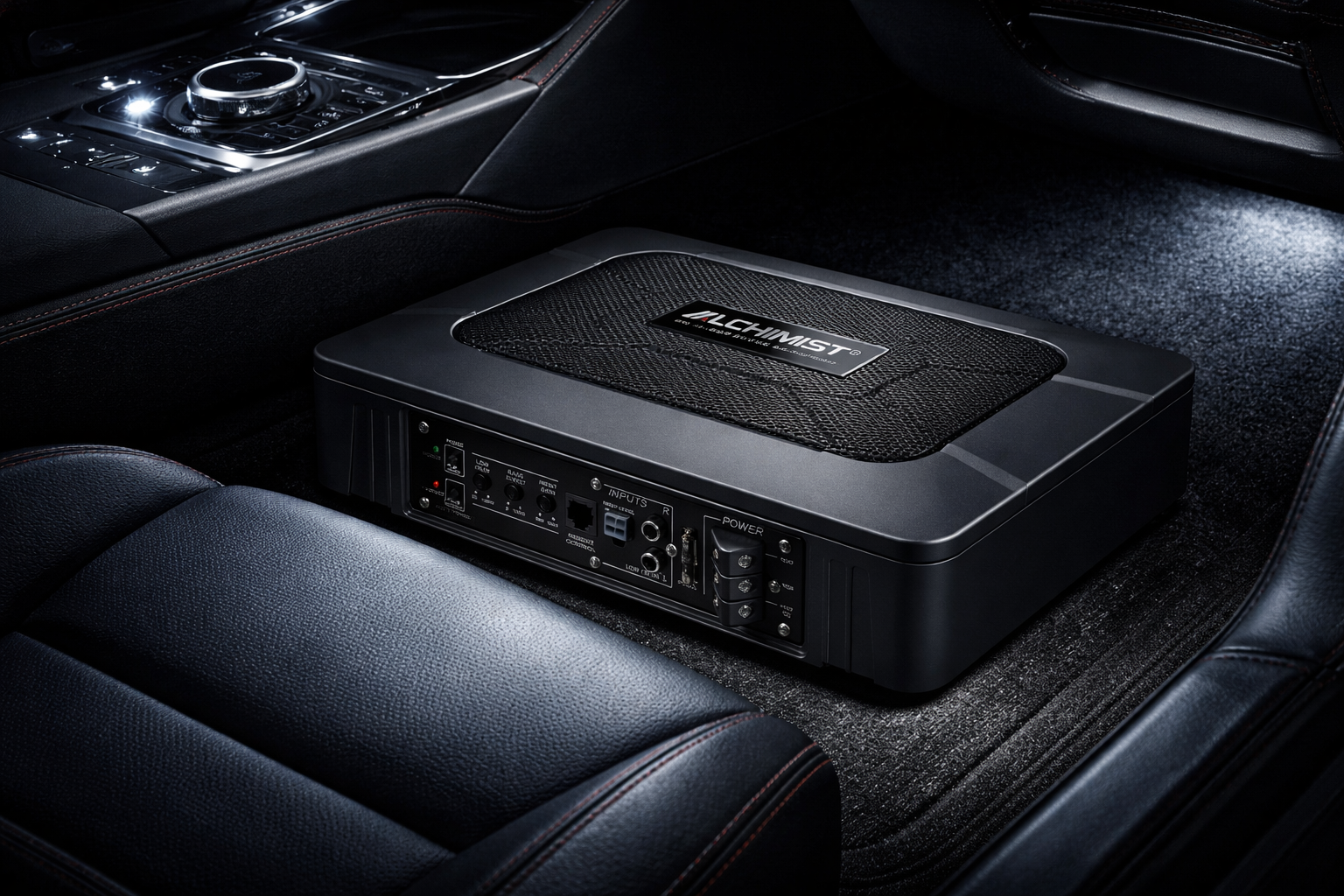
Bass is the backbone of any car audio system. It adds weight and energy to music, and when done well, it fills the cabin with a sense of presence that mid-range and treble alone cannot achieve. But where you place your subwoofer has an enormous influence on how that bass sounds. The two most popular locations are the boot (trunk) and under the front seats. Each approach has genuine strengths and real trade-offs, and the right choice depends on your priorities, your vehicle, and the type of music you enjoy.
How Does Subwoofer Placement Affect Sound Quality?
Low-frequency sound waves are long, ranging from about 3.4 metres at 100 Hz to over 17 metres at 20 Hz. Because these waves are so much larger than the interior of a car, they interact heavily with the cabin boundaries. The position of the subwoofer relative to those boundaries determines which frequencies are reinforced and which are cancelled.
A subwoofer in the boot fires into a partially enclosed space separated from the cabin by the rear seat back. The sound must travel through and around the seats to reach your ears. This path creates a natural low-pass filtering effect and introduces a time delay compared to the front speakers. A DSP processor such as the Alchimist AD10H-700 can correct the time alignment, but the tonal character imparted by the boot cavity remains part of the equation.
An under-seat subwoofer sits much closer to the listening position. The path length to your ears is shorter and more direct, which typically makes the bass feel faster and more integrated with the front stage. However, the trade-off is reduced output capability and less deep-bass extension, because under-seat enclosures are necessarily small.
What Are the Advantages of a Trunk Subwoofer?
A trunk installation gives you the most flexibility in terms of enclosure design and driver size. You can build a properly tuned ported or sealed box, choose a 10-inch or 12-inch driver, and achieve deep, powerful bass that you can feel physically. For listeners who enjoy genres with demanding low-frequency content, such as electronic music, hip-hop, or orchestral film scores, a trunk sub is usually the better choice.
- Enclosure options: Sealed boxes deliver tight, accurate bass. Ported boxes extend the low-end response and play louder at their tuning frequency. Bandpass designs focus energy in a specific range. In the boot, you have room to experiment with all of these.
- Driver size: A larger cone moves more air. A single 12-inch driver in a well-designed enclosure can outperform multiple smaller drivers in terms of both extension and dynamic range.
- Thermal management: Subwoofers generate heat during heavy use. A trunk installation allows better airflow around the motor structure compared to the confined space under a seat.
- Upgrade path: If you start with a modest 10-inch sub and later want more output, the trunk gives you space to add a second driver or move to a larger enclosure.
What Are the Advantages of an Under-Seat Subwoofer?
Under-seat subwoofers prioritise convenience and integration. They are compact, often self-powered, and can be installed without sacrificing any boot space. For people who use their vehicle for daily commuting and need every bit of cargo room, an under-seat solution is extremely practical.
- Space efficiency: The enclosure tucks beneath the driver or passenger seat and takes up no visible space. The boot remains completely free for luggage, shopping, or equipment.
- Shorter signal path: Because the sub is closer to the front speakers, integrating the bass with the mid-range is easier. Time alignment correction in your DSP is smaller, which can result in a more natural transition between the subwoofer and the door speakers.
- Stealth factor: Nothing is visible from outside the car. For owners concerned about security or those who prefer a clean, factory-look interior, this is a significant advantage.
- Easier installation: Many under-seat subs are self-contained units with a built-in amplifier. You connect power, ground, signal input, and remote turn-on, slide the unit under the seat, and you are done. No custom box-building required.
How Do the Two Options Compare for Different Music Genres?
Your listening preferences should guide your choice. Here is a general comparison:
- Rock and acoustic music: These genres rely on punchy, fast bass from kick drums and bass guitars. An under-seat sub in a sealed enclosure handles this well because speed and accuracy matter more than deep extension. A trunk-mounted sealed box also excels here.
- Electronic and hip-hop: Sub-bass content below 40 Hz is common and demanding. A larger trunk-mounted driver in a ported enclosure delivers the pressurisation and depth these genres require. An under-seat unit will struggle to reproduce the lowest octave convincingly.
- Classical and jazz: These genres benefit from subtlety and blending. An under-seat sub, carefully time-aligned using a processor like the Alchimist AD10K-800, can add warmth to double basses and timpani without drawing attention to itself.
- Pop and vocal: A moderate bass lift around 60 to 80 Hz adds body to vocals and fullness to pop arrangements. Either placement works, but an under-seat sub often integrates more seamlessly with the vocal range.
What Role Does the Enclosure Play in Each Setup?
The enclosure is arguably more important than the driver itself. A great subwoofer in a poorly designed box will sound worse than a budget driver in a properly tuned enclosure.
For trunk installations, you have the luxury of building to the manufacturer's recommended volume and tuning frequency. Use the Thiele-Small parameters published for your driver to calculate the ideal box size. If you are using a ported design, ensure the port is long enough to tune to the correct frequency and wide enough to avoid port noise at high output levels.
For under-seat installations, volume is severely limited, usually to between 5 and 12 litres. This forces a sealed design and limits you to drivers with suitable parameters for small enclosures, typically 6.5-inch to 8-inch cones with a low Vas specification. The Alchimist AS-801 is designed specifically for compact installations where space is tight but sound quality cannot be compromised.
How Should You Handle Time Alignment and Crossover Settings?
Regardless of placement, your subwoofer needs to be time-aligned with the rest of the system and crossed over at the correct frequency. A DSP processor makes this straightforward.
For a trunk subwoofer, measure the distance from the sub to the listening position and enter that value into your DSP. The processor will add a delay to the closer speakers so that all sound arrives at your ears simultaneously. Set the low-pass crossover between 60 and 80 Hz for most systems, with a 24 dB per octave slope. Match this with a corresponding high-pass on your door speakers.
For an under-seat sub, the distance difference between the sub and the door woofers is smaller, so less correction is needed. However, because the sub is physically close to you, you may notice localisation cues if the crossover point is too high. Keep the low-pass at or below 70 Hz and use a steep slope to prevent the sub from playing into the mid-bass region where it could be localised under your seat.
Can You Combine Both Approaches?
Advanced systems sometimes use both a trunk subwoofer for deep-bass impact and an under-seat unit for upper-bass punch and blending. This dual-sub approach is common in competition setups. With a processor like the Alchimist AD12H-1500 offering extensive channel count and flexible routing, you can run each sub on its own channel with independent EQ, delay, and crossover settings. This gives you the best of both worlds, although it adds complexity and cost.
What Is the Verdict: Trunk or Under-Seat?
There is no universally correct answer. If you value deep bass extension, high output capability, and are willing to sacrifice some boot space, a trunk subwoofer is the stronger performer. If you need your full cargo area, prefer a discreet installation, and listen mainly to genres that do not demand extreme low-frequency output, an under-seat subwoofer is the smarter choice.
Many enthusiasts begin with an under-seat unit for convenience and later add a trunk sub as their system grows. The beauty of a modular car audio system built around a capable DSP is that you can adapt and expand over time without starting from scratch. Whatever path you choose, take the time to get the enclosure right, set your crossovers carefully, and use time alignment to integrate the bass with the rest of your system. The result will be bass that enhances your music rather than simply overwhelming it.