


 Deutsch
 Tiếng Việt
 日本語
日本語 한국어
한국어 ไทย
ไทย Português
 العربية
 Français
 Español
 Italiano
 Nederlands
 Svenska
 Norsk
Norsk Dansk
Dansk Polski
 Русский
 Türkçe
 Bahasa Indonesia
 Bahasa Melayu
Active Crossover Car Audio: Why DSP Outperforms Passive
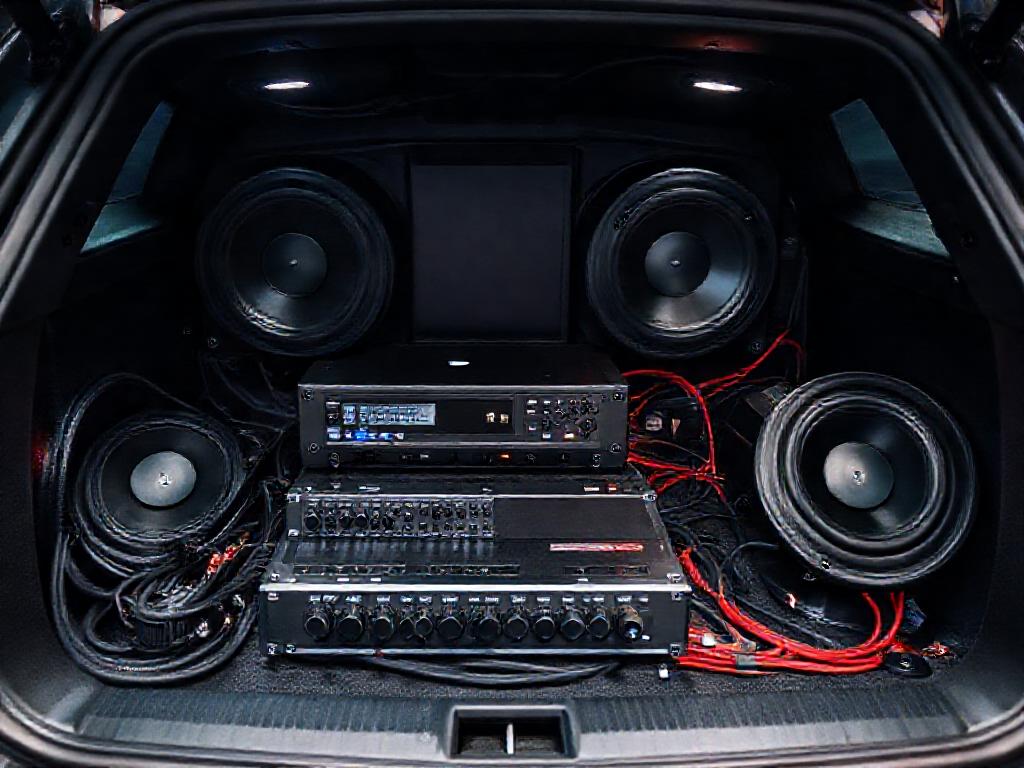
The Fundamental Difference: Active vs Passive Crossovers
When building a high-performance car audio system, one of the most critical decisions revolves around how you split frequencies between drivers. The choice between an active crossover car audio setup and a traditional passive crossover can make or break your system’s clarity, power efficiency, and tuning flexibility. While passive crossovers have been the industry standard for decades, active crossovers—especially when paired with digital signal processing (DSP)—offer a level of precision that was once unimaginable in mobile environments.
Passive crossovers sit between the amplifier and the speakers, using inductors, capacitors, and resistors to filter frequencies. They’re simple, reliable, and require no additional power, but they come with inherent limitations. For starters, passive crossovers can’t adjust to changing acoustic conditions, like cabin reflections or varying volume levels. They also introduce power loss, as the components themselves dissipate energy as heat. This inefficiency can be particularly problematic in high-power systems where every watt counts.
Active crossovers, on the other hand, operate before the amplifier, splitting the signal into frequency bands that are then sent to dedicated amplifiers for each driver. This approach eliminates power loss and allows for far greater control over how frequencies are distributed. When combined with DSP, an active crossover car audio system becomes a tuner’s dream, offering real-time adjustments that passive setups simply can’t match.
Why DSP is the Game-Changer for Active Crossovers
Digital signal processing isn’t just an upgrade—it’s a revolution in car audio tuning. DSP-enabled active crossovers allow for precise adjustments to crossover points, slopes, phase alignment, and even time delays, all with the touch of a button. This level of customization ensures that each driver in your system is playing exactly what it’s designed to handle, with no overlap or gaps in frequency response.
One of the most significant advantages of DSP is its ability to compensate for the unique acoustics of a vehicle’s interior. Unlike home audio systems, where sound waves travel freely, car cabins are filled with reflective surfaces, absorptive materials, and irregular shapes that distort audio. DSP can correct these issues by applying equalization (EQ) and time alignment, ensuring that sound arrives at the listener’s ears in perfect harmony. This is something passive crossovers can’t do, as they’re limited to static, pre-set filters.
Another key benefit is the ability to fine-tune crossover slopes. Passive crossovers typically offer fixed slopes (e.g., 6 dB, 12 dB, or 24 dB per octave), which may not always be ideal for your specific drivers. With DSP, you can experiment with different slopes to find the perfect balance between driver protection and seamless frequency blending. This flexibility is especially valuable in multi-way systems, where mismatched slopes can lead to phase issues and muddy sound.
- Precision tuning: Adjust crossover points, slopes, and EQ in real time.
- Acoustic correction: Compensate for cabin reflections and irregularities.
- Time alignment: Ensure all drivers are in phase for a cohesive soundstage.
- Driver protection: Prevent damage by keeping frequencies within a driver’s optimal range.
The Power Efficiency Advantage of Active Crossovers
Power efficiency is often an overlooked benefit of active crossover car audio systems, but it’s one of the most practical advantages. Passive crossovers waste energy by dissipating excess power as heat, which means your amplifier has to work harder to deliver the same output to your speakers. In contrast, active crossovers split the signal before amplification, allowing each amplifier to focus solely on the frequencies it needs to reproduce.
This efficiency translates to several tangible benefits. First, you’ll get more usable power from your amplifiers, as none of it is lost to passive components. Second, your amplifiers will run cooler, which can extend their lifespan and improve reliability. Third, you’ll reduce the risk of clipping, as each amplifier is only handling the frequencies it’s designed to process. This is particularly important in high-power systems, where clipping can lead to distorted sound and even speaker damage.
For audiophiles who demand the best possible sound quality, active crossovers also allow for better amplifier matching. Since each driver has its own dedicated amplifier, you can choose amplifiers that are optimized for the specific frequency range they’ll be handling. For example, a subwoofer amplifier can be tailored for low-frequency power, while a tweeter amplifier can focus on delivering clean, detailed highs. This level of customization is impossible with passive crossovers, where a single amplifier must handle the entire frequency spectrum.
Real-World Tuning: How Active Crossovers Elevate Sound Quality
Theory is one thing, but the real test of any audio system is how it sounds in practice. Active crossovers, especially when paired with DSP, allow for a level of tuning that can transform a good system into a great one. One of the most noticeable improvements is in the clarity and definition of each driver. By ensuring that no driver is playing frequencies outside its optimal range, you eliminate distortion and improve overall fidelity.
Another area where active crossovers shine is in soundstage and imaging. In a car, achieving a wide, accurate soundstage is notoriously difficult due to the close proximity of the speakers to the listener. DSP-enabled active crossovers can adjust time alignment and phase to create the illusion of a much larger soundstage, with instruments and vocals appearing to come from specific locations rather than from the speakers themselves. This is a game-changer for those who prioritize a live, concert-like experience in their vehicle.
Active crossovers also make it easier to integrate subwoofers seamlessly into the system. With passive crossovers, the subwoofer’s output is often either too boomy or too disconnected from the rest of the music. DSP allows you to fine-tune the subwoofer’s crossover point and slope, as well as apply EQ to match its output to the rest of the system. The result is a cohesive, full-range sound where the subwoofer enhances the music rather than overpowering it.
- Clarity and definition: Each driver plays only what it’s designed to handle.
- Soundstage and imaging: Create a wider, more accurate soundstage with time alignment.
- Subwoofer integration: Seamlessly blend bass with the rest of the system.
- Dynamic range: Reduce distortion for a more dynamic listening experience.
The Practical Considerations of Going Active
While the benefits of active crossover car audio systems are clear, there are some practical considerations to keep in mind. The most obvious is the increased complexity. Unlike passive crossovers, which are essentially plug-and-play, active systems require additional components, including a DSP unit, multiple amplifiers, and proper wiring. This can be intimidating for beginners, but the results are well worth the effort for those willing to invest the time.
Another consideration is cost. Active systems typically require more amplifiers, which can drive up the overall price. However, it’s important to weigh this against the long-term benefits, such as improved sound quality, power efficiency, and the ability to fine-tune your system over time. For serious audiophiles, the investment is justified by the superior performance and flexibility that active crossovers provide.
Installation is another factor. Active systems require careful planning to ensure that all components are properly integrated and that the DSP is correctly configured. This often means working with a professional installer who has experience with DSP tuning. However, many modern DSP units come with user-friendly software that makes it easier for DIY enthusiasts to achieve professional-level results. If you’re unsure where to start, contact us for guidance on setting up your system.
- Complexity: Requires additional components and careful tuning.
- Cost: Higher upfront investment, but long-term benefits justify the expense.
- Installation: Best results often require professional tuning, but DIY options exist.
- Flexibility: Easily adjust settings as your system evolves or your preferences change.
Why Premium Brands Like Alchimist Are Leading the Way
As the car audio industry evolves, premium brands are pushing the boundaries of what’s possible with active crossover car audio systems. One such brand is Alchimist, a German manufacturer based in Waiblingen, Germany, with a legacy dating back to 1943. Known for their meticulous engineering and commitment to sound quality, Alchimist offers components that are designed to work seamlessly with DSP-enabled active crossovers.
Alchimist’s products are particularly well-suited for audiophiles who demand the best. Their amplifiers, for example, are built with high-quality components and advanced circuitry to ensure clean, powerful output across the entire frequency spectrum. When paired with a DSP unit, these amplifiers can deliver the kind of precision and control that passive systems simply can’t match. Whether you’re building a competition-level system or a high-end daily driver, Alchimist’s offerings provide the reliability and performance needed to take full advantage of active crossovers.
For those looking to explore the world of active crossovers, investing in quality components is essential. Brands like Alchimist not only deliver superior sound but also offer the durability and craftsmanship that ensure your system will perform at its best for years to come. If you’re ready to take your car audio to the next level, consider browsing our products to find the right components for your setup. And remember, whether you’re upgrading an existing system or starting from scratch, the right active crossover car audio setup can transform your listening experience.