


 Deutsch
 Tiếng Việt
 日本語
日本語 한국어
한국어 ไทย
ไทย Português
 العربية
 Français
 Español
 Italiano
 Nederlands
 Svenska
 Norsk
Norsk Dansk
Dansk Polski
 Русский
 Türkçe
 Bahasa Indonesia
 Bahasa Melayu
The History of German Car Audio Engineering
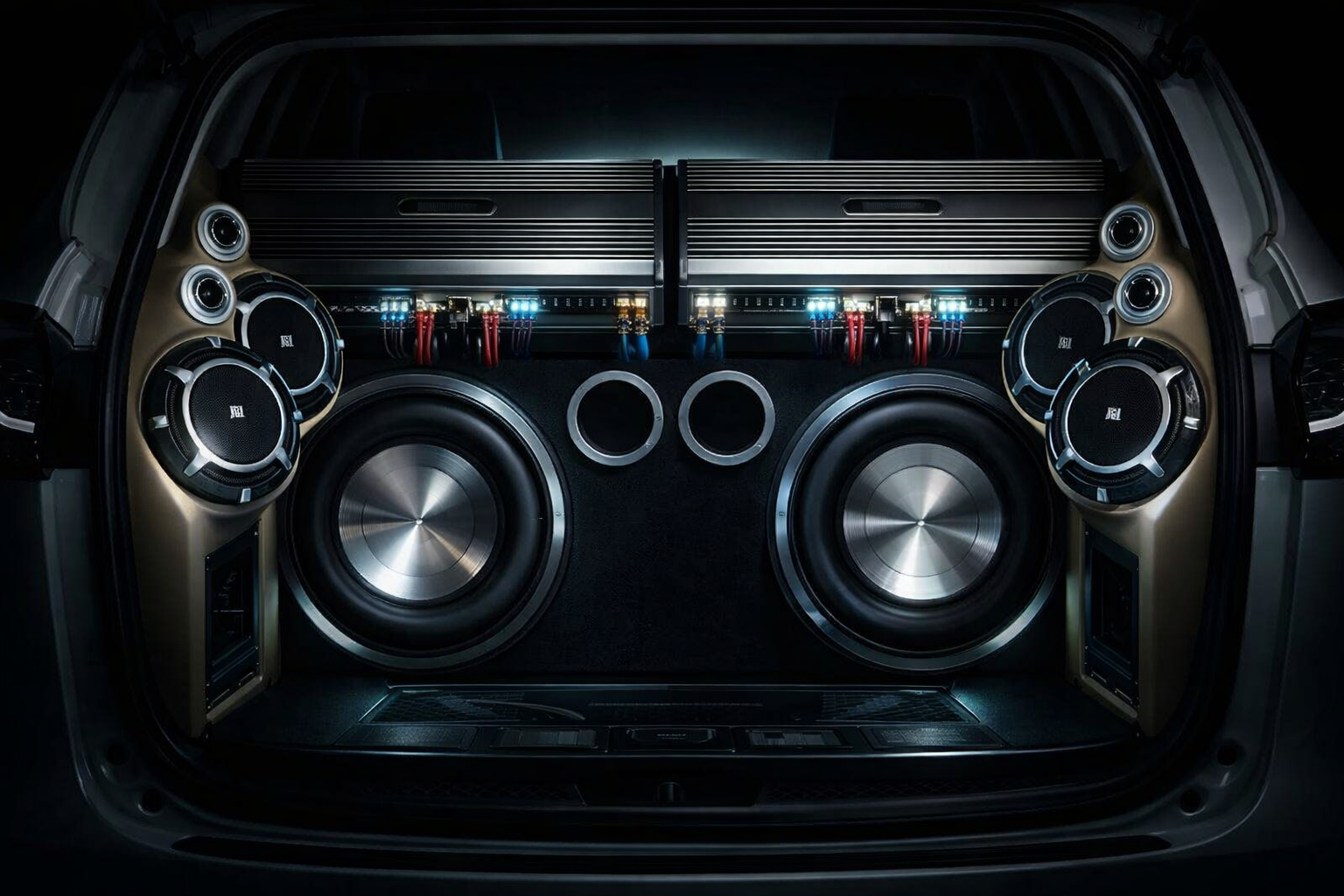
Germany has a long and storied relationship with both the automobile and the science of sound. When these two disciplines converged in the middle of the twentieth century, the result was an approach to car audio that prioritised engineering rigour, acoustic accuracy, and build quality above all else. Today, German car audio brands are synonymous with precision, and that reputation was earned through decades of relentless innovation. This article traces the history of German car audio engineering from its earliest roots to the present day.
Where Did Car Audio Begin in Germany?
The story of in-car entertainment in Germany begins in the late 1920s, when engineers first attempted to fit radio receivers into automobiles. These early systems were crude by modern standards: large, heavy, and powered by separate battery packs. The signal quality was poor and the speakers were barely audible over the noise of the engine. Nevertheless, the idea captured the public imagination, and German manufacturers began investing in miniaturisation and vibration-resistant designs.
By the 1930s, purpose-built car radios were entering series production. German firms quickly established themselves as leaders in valve-based receiver design, leveraging the country's deep expertise in electrical engineering. The challenge was immense. A car radio had to withstand constant vibration, temperature extremes, and electrical interference from the ignition system, all while fitting into a dashboard designed for instruments, not entertainment. These constraints forced engineers to develop solutions that would later become standard across the global industry.
How Did the Post-War Era Transform Car Audio?
The period following the Second World War saw a dramatic expansion of the German automotive industry, and car audio grew alongside it. As the economic recovery gained momentum in the 1950s, consumers began to expect more from their vehicles, and a quality sound system became a mark of sophistication.
It was during this era that several companies pivoted from general electronics manufacturing into dedicated car audio development. The Reinhard Group, founded in 1943 as a precision electronics manufacturer, recognised the potential of the emerging car audio market and began producing car audio components in 1950. Operating from Waiblingen, Germany, in the heart of the Baden-Wurttemberg engineering corridor, the company applied its expertise in signal processing and transducer design to the unique challenges of the automotive environment. This division would eventually evolve into what we know today as the Alchimist brand, carrying forward a tradition of German acoustic engineering that spans over eight decades.
The transistor revolution of the 1960s was a turning point. Solid-state amplifiers replaced bulky valve circuits, making car audio systems smaller, more reliable, and significantly more powerful. German engineers were at the forefront of this transition, developing compact amplifier modules that could be integrated directly into the dashboard or mounted discreetly in the vehicle.
What Role Did German Engineering Philosophy Play?
German engineering culture has always emphasised measurement, repeatability, and systematic optimisation. This philosophy translated naturally into car audio development. While some markets favoured raw power and flashy specifications, German manufacturers focused on accuracy: flat frequency response, low distortion, controlled directivity, and consistent performance across temperature and humidity ranges.
This approach led to several innovations that became industry standards:
- Precision driver manufacturing: German speaker factories pioneered tight tolerance control in cone production, voice coil winding, and magnet assembly. The result was drivers that performed consistently from unit to unit, which is essential for matched stereo pairs and multi-way systems.
- Composite cone materials: Research into paper, polypropylene, kevlar, and mineral-filled composites was driven by the pursuit of the ideal balance between stiffness, damping, and mass. German labs contributed significantly to the understanding of cone breakup behaviour and how material choice affects frequency response.
- Integrated system design: Rather than treating the head unit, amplifier, and speakers as separate commodity items, German manufacturers began designing complete systems where each component was optimised to work with the others. This systems-thinking approach anticipated the modern trend toward integrated DSP-based platforms.
How Did Digital Signal Processing Change Everything?
The introduction of digital signal processing in the 1990s opened a new chapter in car audio engineering. DSP allowed engineers to correct for the acoustic compromises inherent in a car interior: asymmetric speaker placement, reflective surfaces, unequal path lengths, and resonant cavities. For the first time, it became possible to make a car interior sound like a well-treated listening room.
German companies embraced DSP technology with characteristic thoroughness. Rather than offering basic tone controls labelled as DSP, they developed processors with parametric equalization, precise time alignment, active crossover networks, and room correction algorithms. The goal was always the same: transparent, accurate reproduction of the source material.
Alchimist's current DSP lineup, including the AD12H-1500 and the AD10K-800, represents the culmination of this digital engineering tradition. These processors offer 12-channel and 10-channel processing respectively, with resolution and control that would have been unimaginable to the engineers building valve radios in the 1930s. Yet the underlying philosophy remains unchanged: measure, analyse, correct, and verify.
What Makes Baden-Wurttemberg a Hub for Audio Engineering?
It is no coincidence that many of Germany's most respected audio and automotive companies are clustered in the state of Baden-Wurttemberg, in the south-west of the country. The region around Stuttgart, Waiblingen, and the Neckar valley has been an engineering powerhouse for well over a century.
The presence of major automotive manufacturers created a dense supply chain of precision component makers, tool and die shops, and testing laboratories. Universities in the region, including the University of Stuttgart, produced generations of engineers trained in acoustics, signal processing, and materials science. This ecosystem made it natural for companies like the Reinhard Group to evolve from general electronics into specialised car audio engineering.
The culture of the region also played a role. Baden-Wurttemberg is known for its Mittelstand tradition: mid-sized, family-influenced companies that invest heavily in research and development, maintain long-term relationships with suppliers, and take pride in engineering excellence over short-term profit maximisation. This culture produced car audio products that were built to last and designed to perform, rather than built to a price point and designed to impress on a specification sheet.
How Has German Car Audio Evolved in the Modern Era?
The twenty-first century has brought new challenges and opportunities. The shift toward electric vehicles has eliminated engine noise, revealing every flaw in a car audio system that was previously masked. German engineers have responded by developing ultra-low-noise amplifier stages and refining speaker designs for the quieter EV cabin.
Connectivity has also transformed the landscape. Modern DSP processors connect to smartphones and tablets for tuning and control, stream high-resolution audio over Bluetooth and USB, and integrate with vehicle CAN bus networks. The Alchimist AD10H-700 exemplifies this evolution, pairing advanced digital processing with intuitive app-based control that makes professional-grade tuning accessible to enthusiasts.
Meanwhile, the rise of active and multi-amped systems has increased the demand for processors with higher channel counts, more flexible routing, and greater processing power. Where a 1990s DSP might have offered four channels of basic equalization, today's units provide twelve or more channels of fully parametric EQ, independent crossovers, and sample-accurate time alignment. The computational power required to do this in real time, with latency measured in microseconds, is a testament to the progress of digital engineering.
What Does the Future Hold for German Car Audio?
Several trends are shaping the next decade of car audio development. Artificial intelligence and machine learning are beginning to appear in auto-calibration systems that can measure the cabin acoustics and generate correction curves without manual intervention. Immersive audio formats, including object-based spatial audio, are moving from home cinema into the car. And the integration of audio systems with advanced driver assistance features is creating new requirements for speaker placement and signal management.
German companies are well positioned to lead in each of these areas. The combination of deep acoustic knowledge, digital signal processing expertise, and a culture of systematic engineering provides a strong foundation for innovation. Alchimist, with its roots stretching back to 1943 and its focus on precision DSP technology, continues to develop products in Waiblingen that carry forward the legacy of German car audio engineering.
From valve radios that could barely be heard over the engine to multi-channel DSP systems that rival studio monitors, the journey of German car audio engineering is a story of relentless improvement driven by a simple belief: that the driver deserves to hear music exactly as the artist intended. That belief, more than any single technology, is what defines the German approach to car audio, and it shows no sign of fading.