


 Deutsch
 Tiếng Việt
 日本語
日本語 한국어
한국어 ไทย
ไทย Português
 العربية
 Français
 Español
 Italiano
 Nederlands
 Svenska
 Norsk
Norsk Dansk
Dansk Polski
 Русский
 Türkçe
 Bahasa Indonesia
 Bahasa Melayu
Digital Sound Processor (DSP): Your Guide to Perfect Car Audio
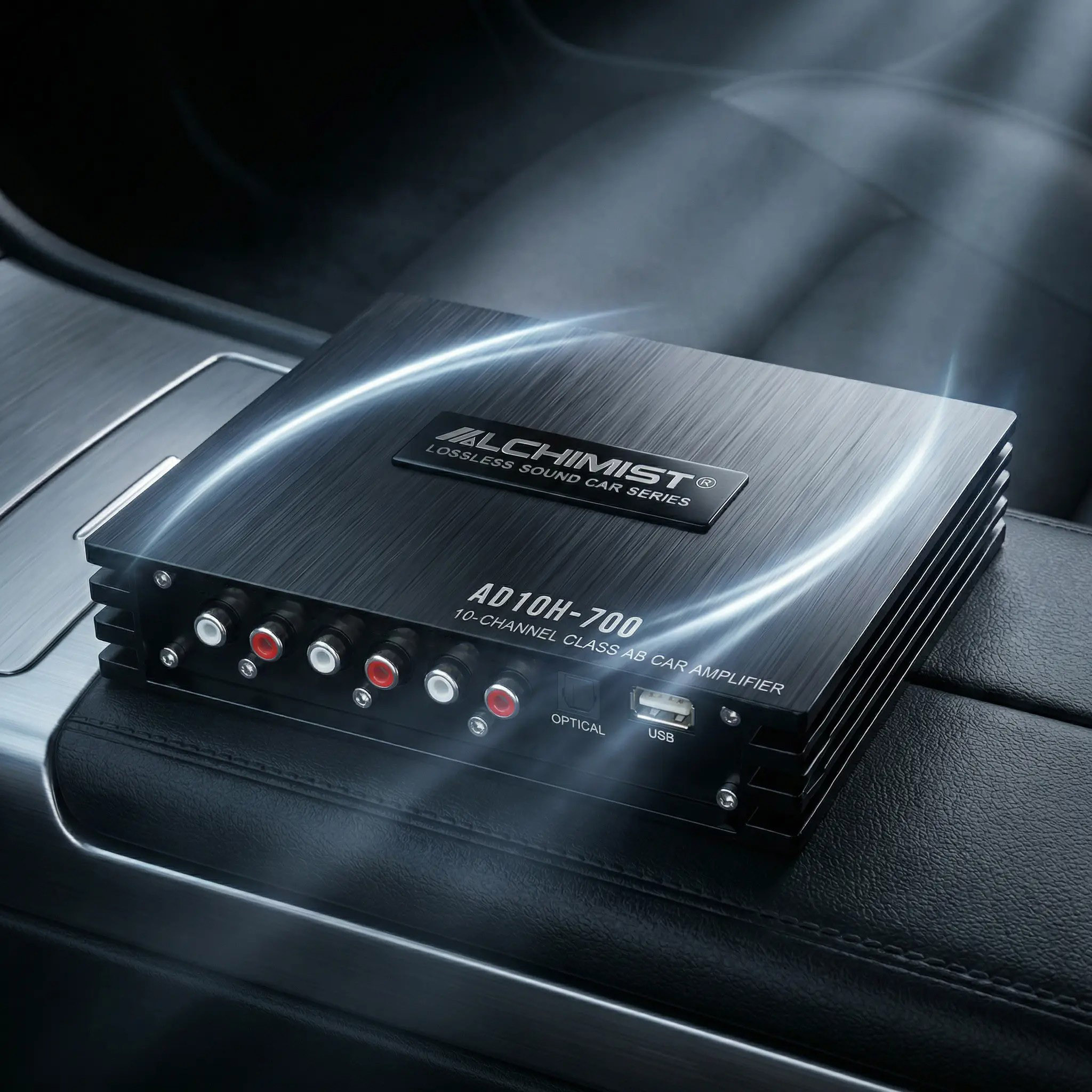
A Digital Sound Processor (DSP) is the brain of a modern car audio system. While speakers produce the sound and amplifiers provide the power, the DSP controls exactly how the audio signal is shaped, corrected, and delivered to each speaker. Without a DSP, even the most expensive speakers and amplifiers cannot overcome the inherent acoustic challenges of a vehicle interior. This guide explains what a DSP does, why it matters, and how to choose the right one for your system.
What Is a Digital Sound Processor?
A DSP is a specialized computer that processes audio signals in the digital domain. It receives the music signal from your head unit, converts it to digital data (if it is not already digital), applies a series of mathematical algorithms to shape the signal, and then outputs the corrected signal to your amplifiers or powered speakers. All processing happens in real time with no perceptible delay.
The processing power of modern DSPs is remarkable. Units like the Alchimist AD12H-1500 use high-performance audio chipsets capable of millions of calculations per second, ensuring every detail of your music is preserved while acoustic problems are corrected.
Core DSP Features Explained
Understanding the key features of a DSP helps you appreciate why it makes such a dramatic difference in sound quality:
Parametric Equalization (EQ)
A parametric EQ provides precise control over the frequency response of each output channel. Unlike a simple graphic EQ with fixed bands, a parametric EQ lets you adjust three parameters for each band: the center frequency, the bandwidth (Q factor), and the gain. Quality car DSPs offer 31 bands of parametric EQ per channel, giving you surgical precision to flatten peaks and fill dips in your vehicle's response curve. The Alchimist AD10H-700 provides 31-band professional parametric adjustment across all channels.
Crossover Management
A crossover divides the audio signal into frequency bands, sending the appropriate range to each speaker. A DSP provides fully configurable digital crossovers that are far more precise and flexible than passive crossovers. You can set the crossover frequency, slope steepness (6 dB/octave to 48 dB/octave), and filter type (Butterworth, Linkwitz-Riley, Bessel) for each channel independently.
Typical crossover settings for a three-way system:
- Subwoofer: Low-pass filter at 60-80 Hz, 24 dB/octave Linkwitz-Riley slope
- Midbass: Band-pass from 80 Hz to 3,000 Hz with 24 dB/octave slopes
- Tweeter: High-pass filter at 3,000-4,000 Hz, 24 dB/octave Linkwitz-Riley slope
Time Alignment (Digital Delay)
Time alignment is arguably the single most important feature of a car DSP. In a vehicle, you sit off-center relative to the speakers. The left door speaker might be 50 cm from your left ear, while the right door speaker is 120 cm from your right ear. This means sound from the left arrives at your ears significantly earlier than sound from the right, pulling the stereo image toward the closer speaker.
A DSP corrects this by adding precise digital delays to individual channels. By delaying the closer speakers, the DSP ensures that sound from every speaker arrives at the listening position simultaneously. The result is a focused, three-dimensional soundstage that appears centered on the dashboard rather than leaning to one side.
Level Control
Each output channel on a DSP has independent level (volume) control. This allows you to balance the output of all speakers so that no single driver dominates the mix. Level balancing is essential after setting crossover points, since different frequency ranges may need different output levels to achieve a natural tonal balance.
Phase Adjustment
Phase refers to the timing relationship between the output of different speakers. At crossover frequencies where two speakers share output, their waves must be in phase (peaks aligned with peaks) to add constructively. If they are out of phase, they cancel each other, creating a deep null in the response. A DSP allows you to invert the polarity of individual channels and make fine phase adjustments to ensure seamless blending between drivers.
Why Every Car Needs a DSP
The acoustic environment inside a car presents unique challenges that no amount of speaker quality can solve alone:
- Asymmetric listening position: You never sit centered between the speakers. Without time alignment, the stereo image is always skewed toward the nearest speaker.
- Reflective surfaces: Glass windshields and windows create strong high-frequency reflections. Fabric seats absorb mid and low frequencies. These surfaces create peaks and dips in the frequency response that only EQ can correct.
- Road noise masking: Continuous noise from tires, wind, and engine masks quiet details in your music. A DSP can reshape the tonal balance to compensate for the masking effect at different driving speeds.
- Compromised speaker placement: Door panels, dashes, and rear decks are chosen for convenience, not acoustics. Time alignment and crossover management let you extract the best performance from imperfect positions.
- Factory head unit correction: Many modern vehicles apply built-in EQ curves and speed-dependent volume adjustments to the factory audio signal. A quality DSP with high-level inputs can detect and flatten these processing artifacts.
The Alchimist DSP Lineup
Alchimist offers a range of DSP processors designed for different system configurations and budgets:
Alchimist AD10K-800
The AD10K-800 is a 10-channel DSP with built-in 800-watt amplification. It features both high-level and low-level inputs, optical digital input, Bluetooth streaming with aptX support, and a unique wireless karaoke microphone input for entertainment. The built-in amplifier powers your entire front stage and subwoofer from a single compact unit, simplifying installation while delivering serious performance.
Alchimist AD10H-700
The AD10H-700 provides 10 channels of pure DSP processing with 700 watts of integrated amplification. It features 31-band parametric EQ per channel, configurable crossovers up to 48 dB/octave, and precision time alignment with 0.01 ms resolution. This unit is ideal for two-way front stage systems with subwoofer output.
Alchimist AD12H-1500
The flagship AD12H-1500 delivers 12 channels of processing with 1,500 watts of onboard amplification. Designed for three-way front stage systems with center channel and subwoofer, it provides the channel count and power needed for competition-level installations. Its advanced chipset handles complex processing chains without artifacts or noise floor issues.
DSP Software Control
The hardware is only half the equation. The tuning software determines how easily and effectively you can configure the processor. Alchimist provides dedicated tuning applications for both PC (Windows) and Android platforms. The software connects to the DSP via USB or Bluetooth, providing real-time control over all parameters.
Key software features include:
- Visual EQ editor: Drag and adjust EQ curves graphically for intuitive frequency shaping.
- Crossover designer: Set crossover points with visual frequency response overlays showing the combined output of adjacent drivers.
- Time alignment calculator: Enter measured distances from each speaker to the listening position, and the software calculates the required delay values automatically.
- Preset management: Save and recall multiple tuning presets for different music genres, listening preferences, or passenger configurations.
- Signal monitoring: Real-time input and output level meters help you identify clipping and set gains correctly.
For a deep dive into the tuning process, see our DSP Tuning Professional Guide.
How to Choose the Right DSP for Your System
Selecting a DSP depends on your system design and future plans:
- Channel count: Count the number of individually amplified speakers in your system. A two-way front stage (tweeter and midbass per side) plus subwoofer needs at least 5 output channels. A three-way front stage with rear fill and subwoofer needs 9 or more.
- Built-in amplification: DSPs with integrated amplifiers simplify installation by combining two components into one. This is ideal if you want clean sound without running separate amp wiring. All Alchimist DSP models feature built-in amplification.
- Input compatibility: Ensure the DSP accepts signals from your head unit. High-level (speaker-level) inputs work with factory radios. Low-level (RCA) inputs connect to aftermarket head units. Digital inputs (optical, coaxial) provide the cleanest signal path.
- Tuning software quality: Download and evaluate the tuning software before purchasing. A powerful processor with clunky software is frustrating to tune and often ends up underutilized.
A DSP is the single most impactful upgrade for any car audio system. It bridges the gap between good equipment and great sound by correcting the acoustic deficiencies inherent in every vehicle. Explore the full range of Alchimist DSP processors and take your car audio from ordinary to extraordinary.